Pesticides, Food and the Fertility Crisis
Every year the Environmental Working Group tests thousands of fruit and vegetable samples for pesticide residues and publishes two lists. The Dirty Dozen tells you which produce carries the heaviest pesticide loads. The Clean Fifteen tells you which is safe to buy conventional.
Knowing these two lists is one of the highest impact things you can do for your health without dramatically changing your diet or your budget. You do not need to buy everything organic. You just need to know which things matter most.
Why Washing Does Not Solve the Problem
The most common assumption people make is that washing fruit and vegetables thoroughly removes pesticide residues. It removes some of them. But the pesticides used on most conventional produce are systemic, meaning they are absorbed into the plant as it grows. They are inside the flesh of the fruit, not just on the surface. No amount of washing removes a chemical that is already inside the food.
Peeling helps for some produce but not all. Strawberries cannot be peeled. Spinach cannot be peeled. Apples are often eaten skin on. For soft-skinned fruit and leafy vegetables, buying organic is the only way to meaningfully reduce your pesticide exposure.
The Dirty Dozen 2026
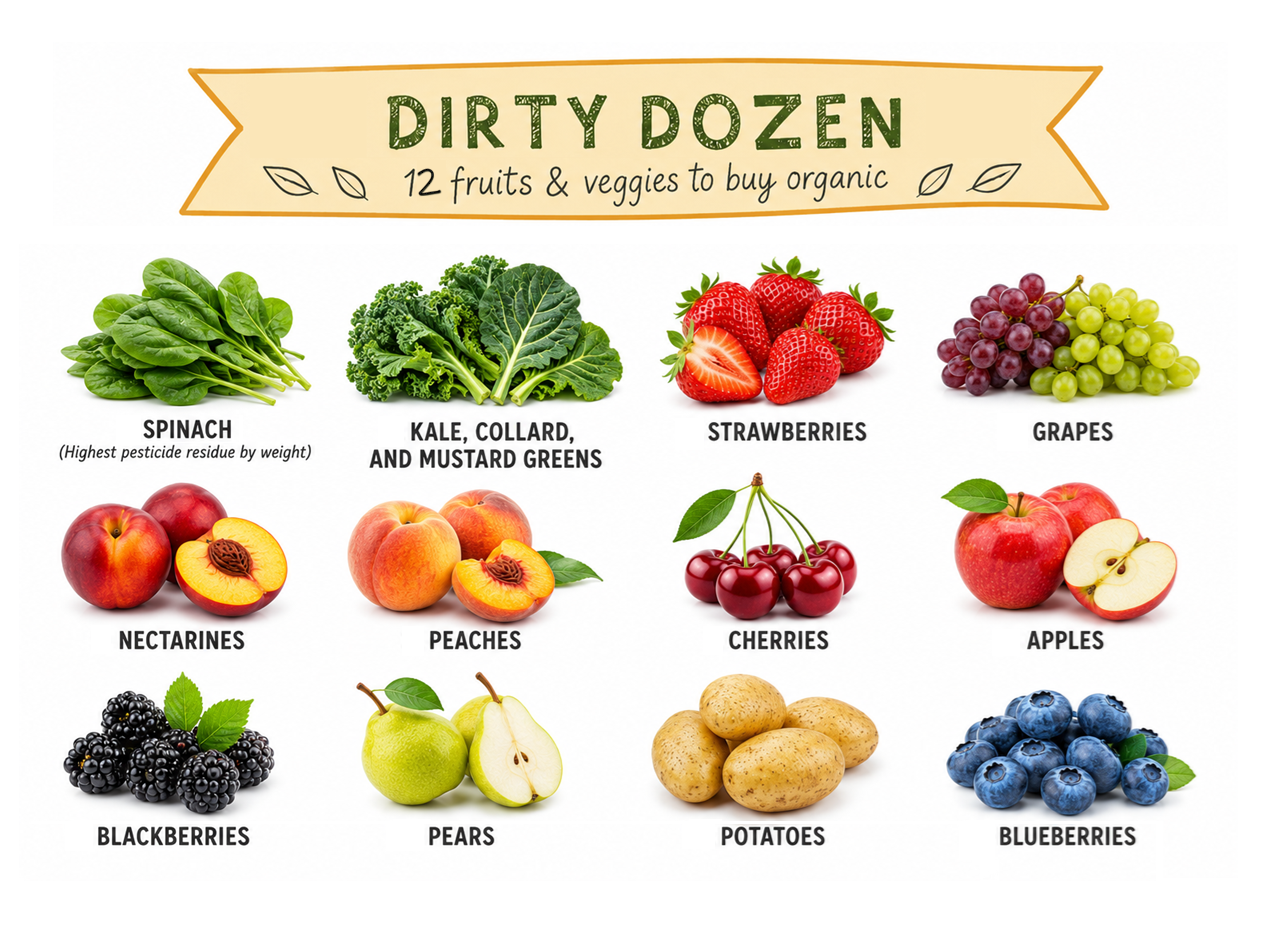
These are the twelve fruits and vegetables where buying organic makes the most meaningful difference. They consistently carry the highest pesticide residue loads when grown conventionally.
Always buy these organic:
1. Spinach
2. Kale and leafy greens
3. Strawberries
4. Grapes
5. Nectarines
6. Peaches
7. Cherries
8. Apples
9. Blackberries
10. Pears
11. Potatoes
12. Blueberries
Also worth buying organic if you eat them regularly:
Bell peppers, hot peppers and green beans narrowly missed the 2026 Dirty Dozen cutoff but ranked at the very top for overall pesticide toxicity. EWG specifically flagged all three. If you eat any of them regularly, buying organic is strongly advisable.
New for 2026: PFAS forever chemicals found in produce for the first time
The 2026 report found PFAS pesticides on 63% of all Dirty Dozen produce samples. The most frequently detected pesticide across all produce tested was fludioxonil, a PFAS fungicide. This means that buying organic is now not just about avoiding conventional pesticides but also about reducing your exposure to forever chemicals from agricultural use.
Spinach and kale now top the 2026 list based on both the quantity and toxicity of detected pesticides. Spinach regularly tests with some of the highest pesticide loads of any produce. Kale, collard and mustard greens are worth particular attention as they ranked at the very top for overall toxicity of detected compounds.
Potatoes are a notable addition to the 2026 list. 90% of potato samples tested contained chlorpropham, a sprout inhibitor that is banned in the EU due to health concerns but still used in conventional potato farming in other countries that export to the UK. Buying organic potatoes specifically avoids this compound entirely.
Blackberries also appear on the 2026 list for the first time, averaging more than four different pesticides per sample tested.
The Clean Fifteen 2026
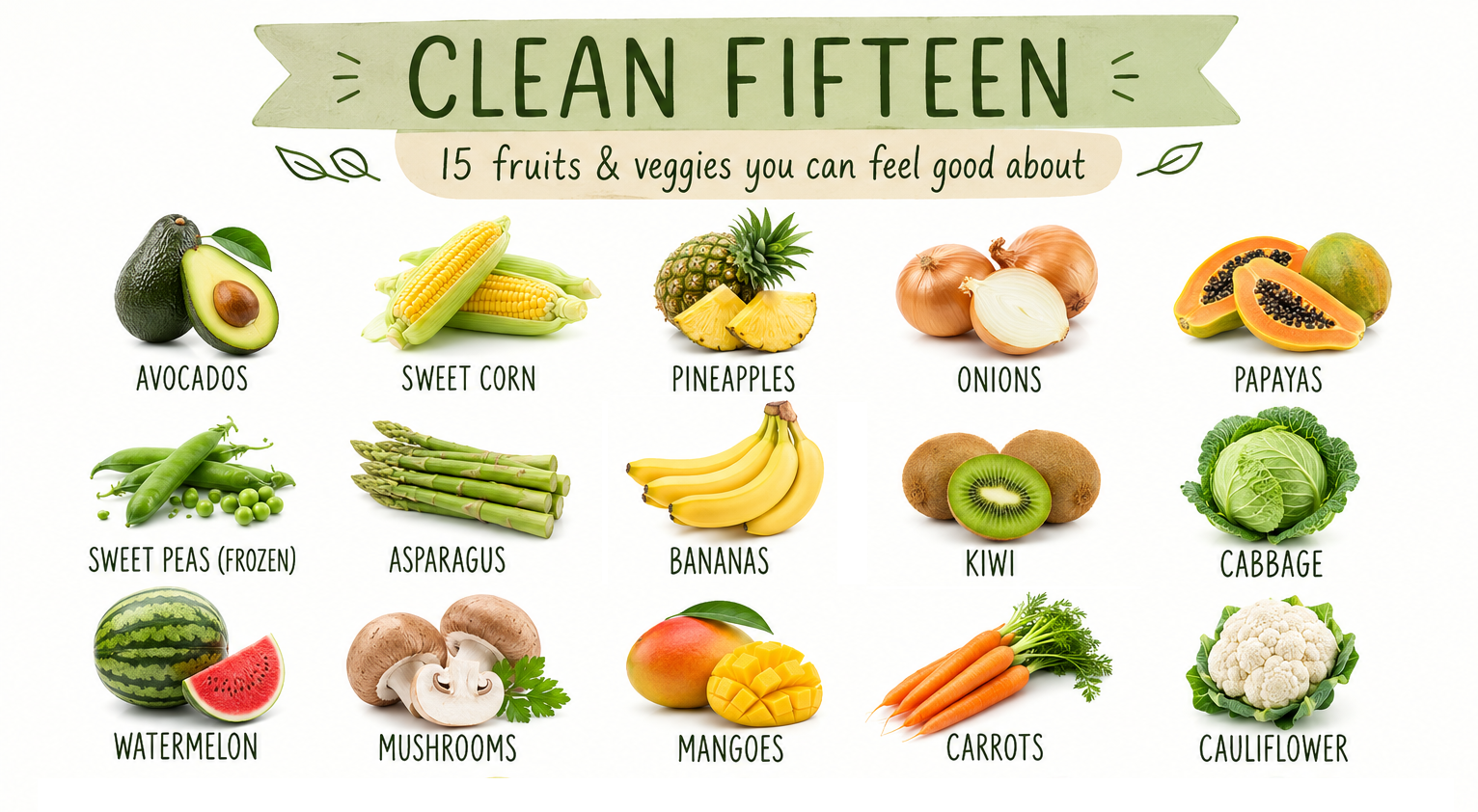
These fifteen fruits and vegetables consistently show the lowest pesticide residue levels when grown conventionally. Their thick outer skins or natural protective layers mean the edible portion carries very little of what was applied during growing. Buying organic versions of these is an unnecessary expense.
Conventional is fine for these:
1. Pineapple
2. Sweet corn
3. Avocados
4. Papaya
5. Onions
6. Frozen sweet peas
7. Asparagus
8. Cabbage
9. Cauliflower
10. Watermelon
11. Mangoes
12. Bananas
13. Carrots
14. Mushrooms
15. Kiwi
Avocados consistently test as one of the cleanest conventional options available. Their thick skin acts as an effective barrier and nearly all samples tested show no detectable pesticide residues on the edible flesh. The same principle applies to pineapple, onions, asparagus and cabbage.
Knowing this list matters as much as knowing the Dirty Dozen. Your organic budget goes further when it is focused only where it makes a real difference.
What This Means for Fertility
DR SHANNA SWAN Environmental and Reproductive Epidemiologist, Mount Sinai
On buying organic to avoid pesticides and why phthalates are actually added to pesticides as an absorption enhancer.
JEREMY GRANTHAM Investor and Environmentalist
On two small Harvard studies linking pesticides on food directly to fertility outcomes studies he says are too important to ignore.
The evidence connecting pesticide-contaminated produce to fertility outcomes is some of the clearest in this area of research. A study published in Human Reproduction followed 180 men at a fertility clinic over six months. The researchers tracked one variable: how much pesticide-contaminated produce each man was eating.
Men eating the least pesticide-contaminated produce had double the sperm count of those eating the most. The only variable was food choice.
A follow-up study with women at the same clinic found that those eating cleaner diets had a 68% rate of successful live births compared to 38% in the group eating the most contaminated food. Nearly double, from food choices alone.
The Dirty Dozen list gives you the most direct practical tool for acting on this research. The twelve produce items on it are the ones where switching to organic has the most immediate effect on your pesticide body burden.
How to Shop Organic on a Budget in the UK
Organic does not have to mean expensive. Here are the most practical ways to buy organic Dirty Dozen produce without significantly increasing your weekly food bill.
Buy everything on the Clean Fifteen conventionally. This single strategy means you are spending organic prices only where it genuinely matters and saving money everywhere else.
Riverford and Abel and Cole offer organic produce delivery at prices that are often comparable to supermarket organic ranges, sometimes cheaper. Both are Soil Association certified and B Corp certified. A weekly veg box is one of the most cost effective ways to eat organic consistently.
Sainsbury's SO Organic, Waitrose Duchy Organic and Tesco Organic all offer Soil Association certified produce at prices significantly lower than premium organic brands. The certification is the same regardless of the label.
Frozen organic spinach and organic berries are significantly cheaper than fresh organic equivalents and retain their nutritional value. For smoothies, soups and cooked dishes where fresh texture is not essential, frozen organic is an excellent option.
If you eat spinach every day, switch that to organic first. If you only eat blueberries occasionally, they are lower priority. The more frequently you eat something on the Dirty Dozen, the higher the impact of switching to organic.
Start with one item this week. If you eat strawberries regularly, switch those to organic. That single change puts you ahead of where most people will ever get to, and it costs less than a coffee.
Related reading: our Food and Nutrition page covers clean protein sources, food storage without plastic, and how to shop clean on a real budget.
Sources: Environmental Working Group Dirty Dozen and Clean Fifteen 2026 | Chavarro et al., Human Reproduction (2011) dietary pesticide intake and male fertility | Chiu et al., Human Reproduction (2018) dietary pesticide intake and female fertility outcomes | UK Pesticide Residues Committee Annual Report 2025
WANT THE FULL PICTURE?
Jeremy Grantham covers pesticides, PFAS and the global fertility crisis in full including why he believes the evidence is already strong enough to act on and what he thinks needs to change at a societal level.
Watch the full Jeremy Grantham interview →