The Sugar Nobody Told You About
A bowl of cornflakes. A baked potato. A plate of white rice. Most people would not call any of these sugary foods. Dr David Unwin, one of the UK's most respected GPs, spent 25 years not calling them sugary foods either. Then a patient walked into his surgery and told him he was wrong.
JUMP TO
How much sugar is actually in there
Why this connects to chemical exposure
In 2012, after a quarter of a century in general practice north of Liverpool, Dr Unwin was close to quitting. His patients were getting sicker. He was prescribing more drugs than ever. And despite following clinical guidelines to the letter, nothing was improving. Then a woman he had known for ten years came into his surgery and told him off.
She had stopped taking her metformin, the standard drug prescribed for type 2 diabetes. He had written to her, concerned. She arrived furious. She said: did you ever once tell me that bread was sugar? That rice was sugar? That breakfast cereals were sugar? I had to learn that online. And when I cut those foods, I no longer needed your metformin.
Her blood test confirmed it. It was the first case of drug-free type 2 diabetes remission Dr Unwin had seen in 25 years of practice.
She went further. She said: this is school-boy biology. You should have learned it when you were sixteen.
She was right. And what she understood, that most people do not, is the single most important thing this article asks you to sit with: starch is sugar. Glucose molecules holding hands. The moment digestion begins, those hands let go, and what looked like bread or rice or potato becomes free glucose in your bloodstream, indistinguishable from the sugar you stir into your tea.
How much sugar is actually in there
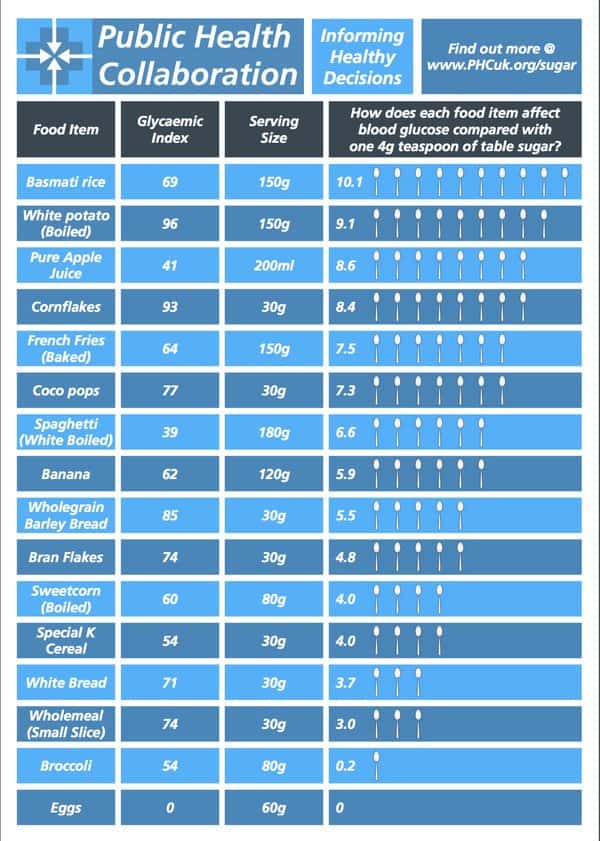
Dr Unwin developed a way of communicating this that has since travelled around the world. He converts the glycemic load of common foods into teaspoon equivalents of sugar, because grams of glucose means nothing to most people, but teaspoons of sugar mean something immediate.
The human body, in its entire blood volume of approximately five litres, maintains the equivalent of roughly one teaspoon of sugar at any given time. That is the normal range. The body works constantly to keep it there because glucose is vital, but also toxic if it exceeds that narrow margin.
Against that backdrop, here is what a standard serving of common foods actually delivers:
Teaspoon equivalents of sugar per standard serving:
Plain cornflakes, one bowl, no frosting: 8 teaspoons
Baked potato, medium: 9 teaspoons
Boiled white rice, 150g: 10 teaspoons
Ripe banana: 6 teaspoons
Milk chocolate bar: 7 to 8 teaspoons
White chocolate: 70 to 80% white sugar by composition
Standard bottle of barbecue sauce: 30 teaspoons
The cornflakes figure is the one that stops people. There is no sugar listed in the ingredients. There is no frosting. And yet a bowl of plain cornflakes delivers eight times the sugar equivalent of your entire normal blood glucose load. The reason is that cornflakes are almost entirely starch, and starch is glucose molecules holding hands. Digestion breaks them apart almost immediately. The resulting blood sugar spike is rapid, substantial, and demanding on the pancreas.
The rice figure is similarly arresting. White rice is widely regarded as a clean, healthy food. A standard 150g portion of boiled rice delivers the equivalent of ten teaspoons of sugar. If you have poorly controlled type 2 diabetes, as Dr Unwin has himself, a banana alone will double your blood sugar because your body can no longer regulate the spike efficiently.
What the body does with it
When you eat carbohydrates, your blood glucose rises. Your pancreas responds by releasing insulin, the hormone whose job is to push that glucose out of the bloodstream and into cells where it can be burned for energy. If you take in more glucose than your cells need to run on, insulin converts the surplus to fat and stores it, most commonly in the belly and in the liver.
A fatty liver is not just a cosmetic or incidental problem. A liver filling with fat begins to interfere with the very process of insulin signalling. The liver becomes insulin resistant, meaning insulin no longer works as efficiently as it should. The pancreas responds by producing more insulin. But it is also filling with fat. And eventually the pancreas cannot keep up. Blood sugar rises and stays high. This is type 2 diabetes.
The clinical term for the slow, silent process of fat accumulating in the liver over years before symptoms appear is the long silent scream from the liver, a phrase coined by Professor Roy Taylor of Newcastle University, who has spent decades researching the reversibility of type 2 diabetes. The process typically takes around ten years. Most people have no idea it is happening.
According to UK government data, a third of all people with type 2 diabetes do not know they have it. And for every year that type 2 diabetes goes poorly controlled, the evidence shows you lose approximately 100 days of life expectancy.
Why this connects to chemical exposure
This site exists primarily to document the connection between everyday chemical exposures and hormonal health. So why does ultra-processed food belong here?
Because the connection is not just thematic. It is chemical and direct.
A 2024 study published in Diabetologia by researchers at Johns Hopkins University found that packaging contaminants in ultra-processed foods, specifically phthalates, bisphenol A and PFAS, are directly linked to endocrine disruption, inflammation and insulin resistance. These are the same chemicals documented throughout this site in the context of fertility, reproductive health and hormonal disruption. They are present not just in the packaging but in the food itself, migrating from plastic wrappers, coatings, processing machinery and storage containers.
A further paper published in Frontiers in Nutrition in 2023, co-authored by Professor Robert Lustig of the University of California San Francisco, one of the world's leading authorities on metabolic disease, described ultra-processed food explicitly as acting as an endocrine disruptor in a peer-reviewed journal. The Standard Western Diet, the paper argued, disrupts the gut microbiome, damages the liver through fructose overload, promotes insulin resistance and interferes with the brain's satiety signalling.
Insulin resistance is itself a hormonal disruption. The conversation about ultra-processed food and the conversation about chemical exposure are not two separate conversations. They are one.
The label is not telling you the truth
The food industry is very skilled at obscuring this. The word fruit on a product creates what Dr Unwin calls a halo assumption. If it says fruit, it must be healthy. Dried mango chips are 60 to 70 percent sugar by composition. Orange juice, once extracted from its fibre matrix and consumed as a liquid, produces a blood sugar spike faster than an equivalent quantity of Coca-Cola.
Smoothies carry the same halo. So does fruit yoghurt. So do cereal bars. So does anything labelled natural, wholesome, energy-giving or made with real ingredients. None of these words have a regulated definition in UK food labelling law. They mean whatever the marketing department wants them to mean.
What the label is legally required to tell you is the carbohydrate content. In the UK, carbohydrate listed on a nutrition label means carbohydrate that turns to sugar, not including fibre. Every four grams of carbohydrate is broadly equivalent to one teaspoon of sugar in terms of its effect on blood glucose. This is the number to look at.
What actually helped
Dr Unwin's published research, based on eight years of data from 186 patients at his NHS practice, found that a lower carbohydrate approach produced drug-free type 2 diabetes remission in 51 percent of cases overall. Among those who adopted it within the first year of diagnosis, remission was achieved in 77 percent. Among those who waited more than five years, the chance of remission dropped to 50 percent.
His patients also saw their liver function improve within weeks. Their blood pressure dropped. Their weight fell. Their need for medication reduced. He reversed his own type 2 diabetes. His wife Jen, a clinical health psychologist who co-developed the programme, reversed her ultra-processed food addiction. His practice went from last place to first place in the region for diabetes control, while spending the least on diabetes drugs.
The approach is not extreme. It is not about counting calories or going hungry. In fact the first thing most patients noticed was that they were no longer hungry between meals. When blood sugar is stable, the cycle of spike and crash that drives constant snacking simply stops.
The core principle is to base meals on protein, add green vegetables, use full fat dairy, olive oil and butter rather than low fat alternatives, and remove or dramatically reduce bread, rice, pasta, potatoes and breakfast cereals. Not forever necessarily, and not identically for everyone, because how efficiently your body handles carbohydrate depends on how much insulin resistance you already have. But as a starting point, it is simple and it is evidenced.
A note on magnesium
One practical supplement point worth including here, because it sits at the intersection of metabolic health, hormonal health and the soil depletion story that runs through this site. Dr Unwin notes that magnesium deficiency is now extremely common, not because people are eating badly but because modern agricultural soil has been depleted of magnesium to the point where even a good diet no longer provides enough. This is compounded by the fact that several common medications, particularly those for acid reflux, interfere with magnesium absorption.
Magnesium plays a role in insulin sensitivity, sleep, mood and muscle function. For sleep and mood specifically, magnesium glycinate or threonate is the most useful form because it crosses the blood-brain barrier. For constipation, magnesium citrate is more appropriate. Blood serum magnesium tests do not accurately reflect true magnesium status because magnesium is stored primarily inside cells. The simplest approach, as Dr Unwin suggests, is to try a supplement and see how you feel.
The bigger picture
UK health span, the number of years people live in good health rather than simply alive, is declining even as overall lifespan slowly increases. People are now spending roughly 23 years at the end of their lives in poor health. The average UK taxpayer pays an estimated £7,000 per year in additional tax to cover the healthcare and lost productivity costs of ultra-processed food consumption.
Diet is the second most common cause of cancer after smoking. Eight forms of cancer are strongly associated with type 2 diabetes. These are not fringe claims. They are the conclusions of peer-reviewed research and NHS data.
None of this is happening because people are making foolish choices. It is happening because the food environment has been engineered to obscure what is actually in the food, to create products that override normal satiety signals, and to market those products as healthy using language that has no legal definition. The awareness gap is not accidental.
What Dr Unwin showed in his practice, and what the research consistently supports, is that once people understand what the food is actually doing in the body, many of them choose differently. Not because they have been told to. Because they want to.
THE RESEARCH BEHIND THIS ARTICLE
Unwin D et al. What predicts drug-free type 2 diabetes remission? BMJ Nutrition, Prevention and Health, 2023.
Welch Center, Johns Hopkins University. Ultra-processed food consumption and risk of diabetes. Diabetologia, 2024.
Harlan TS, Lustig RH et al. The Metabolic Matrix. Frontiers in Nutrition, 2023.
This article draws on the Diary of a CEO interview with Dr David Unwin and peer-reviewed research listed above. It is intended to inform and does not constitute medical advice. If you have concerns about blood sugar, insulin resistance or diabetes, speak with your GP.